Hi, I'm Kiko
I'm a software engineer and startup co-founder based in Auckland CBD, with experience across software and product management. I like working on practical problems, learning deeply, and building things that are useful.
About Me
In high school, I was set on the MAANG dream. I spent most of my free time grinding leetcode and reading resources on interview prep. But in my second year of university, I discovered the entrepreneurship space and my goals started to shift.
I started focusing less on how to build, and more on what to build and why. Understanding user behaviour, identifying pain points, and thinking about the ways software can solve problems is more interesting than treating engineering as a purely technical exercise.
Since graduating, all my roles have been self led. I'm no longer focusing on just the code, but the end user as well. I enjoy working on things that haven't been done before, first by understanding the problem, what is currently being done about it (and why), and then scoping a solution to build.
Experience
Co-founder | Software + Product
Lighthouse | Aug 2022 – Present
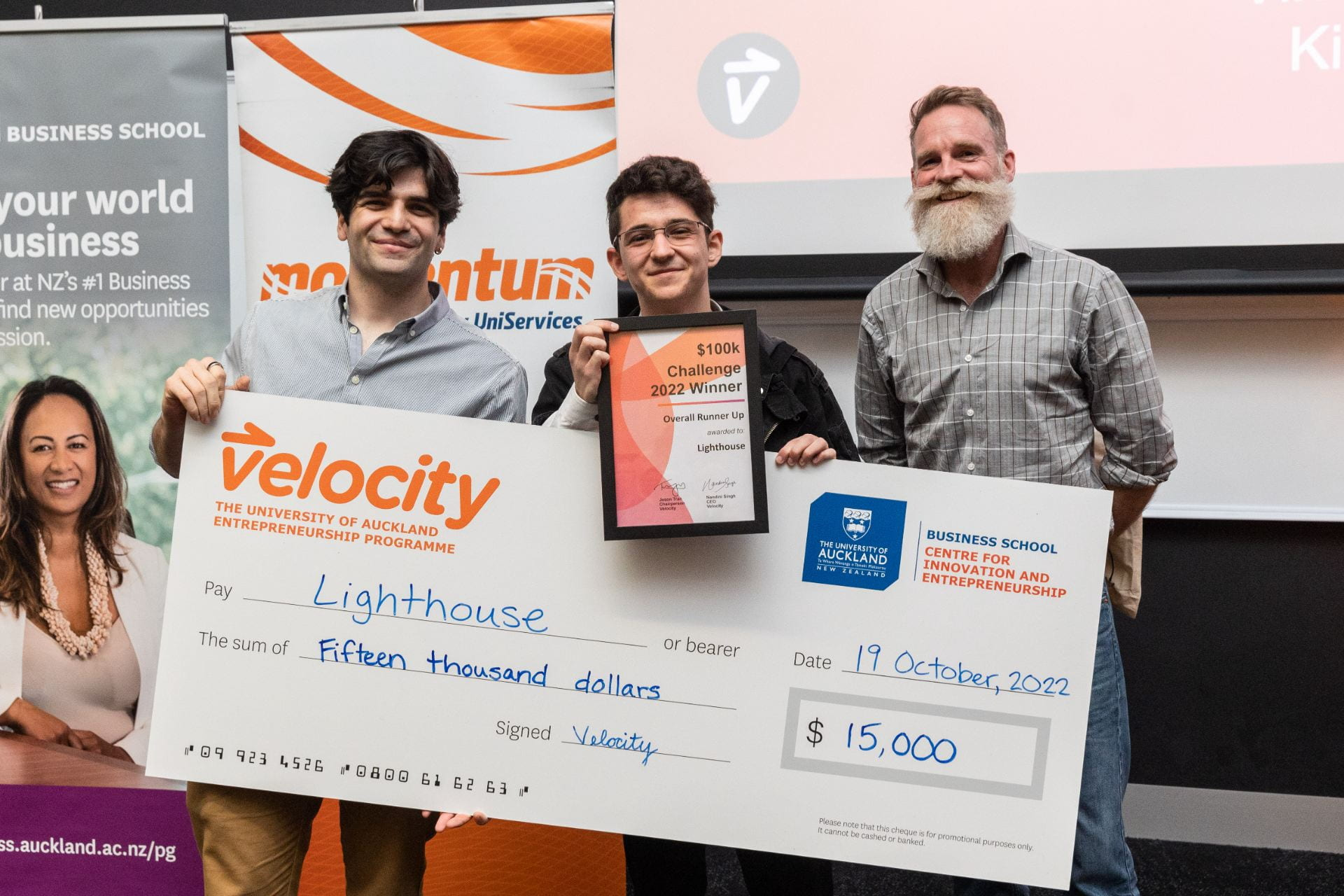
Lighthouse is a healthtech startup out of the University of Auckland. My co-founder and I placed runner-up in the 2022 Velocity $100k Challenge. We have spent a significant amount of time understanding the day-to-day challenges faced by New Zealand Primary Care Health Improvement Practitioners.We built a bespoke interface tailored to the needs of these clinicians. We have also been working to run a clinical pilot, navigating the procurement process in NZ digital health.
- Serving as the primary technical liaison with the ProCare executive leadership team, translating clinical requirements into product specifications.
- Conduct customer interviews and workflow discovery sessions with practitioners, translating clinician pain points into product requirements and interface designs.
- Designed and architected a web application to run as a clinical pilot. Built the frontend, API structure, and database schema.
- Liaised with an offshore development team to deliver a grant-funded tablet-based MVP.
- Mentored an intern across engineering tasks.
- Presented the company to investors, and early-stage judging committees.
- Managed the company website.
Freelance Software Engineer
Promovision | Jun 2024 – Present
I was a freelance developer responsible for rebuilding Promovision's outdated PrestaShop website. The site turned into a development passion-project of mine to see how far I could push the performance and lower the hosting costs.Promovision needed to stay up to date with changes in supplier pricing and branding options. I integrated the supplier APIs (TRENDS, AS Colour, Logoline) with the headless CMS and built a live quoting calculator that allowed users to browse prices of different branding options in real-time.Beyond the technical work, the role involved requirements gathering, improving SEO performance, and exploring new marketing strategies. At the time of writing, the site has 2.3k active monthly users.
- Rebuilt the company website from the ground up with a modern React and Next.js stack.
- Designed and implemented supplier API integrations for automatic pricing and stock level updates.
- Developed a bespoke quote calculator that gave customers self-service pricing workflows.
- Built a headless CMS using Strapi for product and content management.
- Deployed and managed a self-hosted Meilisearch instance for fast product search.
- Managed AWS infrastructure, including EC2, RDS, S3, CloudFront, and Lambda functions.
- Implemented the site initially using Remix (an SSR setup), and then migrated to Next.js (SSG) to further improve performance and hosting costs.
- Currently manage SEO, Google Ads, and Google Analytics. Increased avg. site rank from 24th to 16th, avg. engagement time per active user by 68.2%, and avg. monthly web conversion rates by 50%.
Software Engineering Intern
Serato | Nov 2022 – Feb 2023 & Nov 2023 – Feb 2024
I worked in the web team during both of my internships at Serato. My team took on technical work that didn't fit neatly within other teams' responsibilities. Our work involved modernising legacy systems with a mix of improving both developer and customer-facing workflows.I had a taste of many areas of software, with tickets across DevOps, microservice systems architecture, payment processing, refactoring efforts, CI/CD, and testing suites.
- Migrated authentication services toward modern OAuth 2.0 PKCE-based flows.
- Helped modernise legacy CI/CD infrastructure by migrating build pipelines from Travis CI to GitHub Actions.
- Assisted in migrating development environments away from ChefDK tooling to Docker.
- Contributed to early architectural work for abstracting payment processing away from a single tightly coupled provider model, enabling future multi-provider and region-specific payment support.